shopping_basket
H-shaped channel for boundary flow experiment - 350 x 150µm
SKU
11003577
Availability:
check_circle In stock
$416.59
per pack of 3
H-shaped flow channel, ideal for boundary flow experiments. The channels have a width of 350µm and height of 150µm.
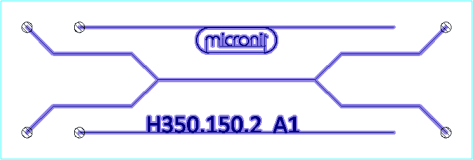
This H-shaped flow channel is an ideal solution for boundary flow experiments in which two liquids will flow in parallel and only diffusion will occur at the interface of both flows.

The channels are etched into borosilicate glass (D263 Eco) which creates extremely smooth channels which are fully transparent.
The channels have a width of 350µm and height of 150µm.
The main channel has a length of 14.8mm, the inlet/outlet structures a length of 14.5mm
The channel profile is as follow:

The chip has a thickness of 1.8mm, the height above the channel is 950µm.
The height below the channel is 700µm.
| Unit of measurement | pack of 3 |
|---|---|
| Interface type | Topconnect |
| Chip material | Borosilicate glass - D263 |
| Chip thickness | 1.8mm |
| Number of inlets | 2 |
| Number of outlets | 2 |
| Channel Width | 350µm |
| Bottom thickness | 700µm bottom layer |
| Coating | No coating (hydrophilic) |
Customer Questions
Related Products
We found other products you might like!
-
 Observation starter kit - topconnect (incl. syringe pumps)
As low as $4,073.05
- Product bundle with interfacing and microfluidic chips
From $2,132.84
To $26,951.83