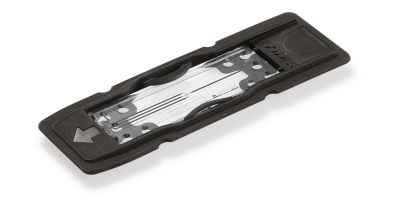
Focused flow droplet generator - nozzle 50µm - coated - topconnect

SKU
11006011
Availability:
check_circle In stock
$787.92

per pack of 3

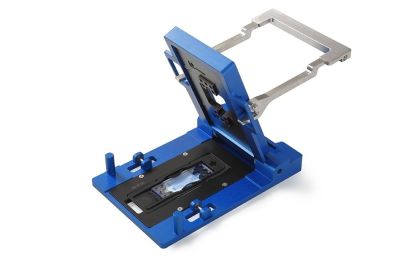
Pack of 3 hydrophobic coated focused flow droplet generator chips with a nozzle size of 50µm. For use in combination with our topconnect interfacing. 

Recommended reference droplet size range: 40-90µm
For creating water-in-oil droplets.

The reference droplet size range is based on a reference experiment with Silicone oil 5cSt and DI water combined with 2% v/v Tween 20 or Tween 80.
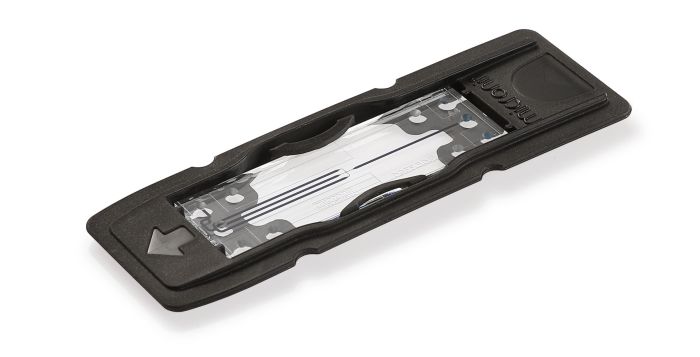
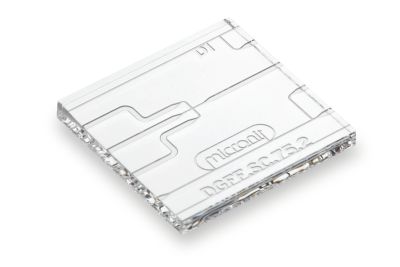
Pack of 3 hydrophobic coated focused flow droplet generators. The channels have an oval shape and the design fetaures a nozzle with a height of 50µm and a width of 72µm which is located in the exit channel at the junction. 
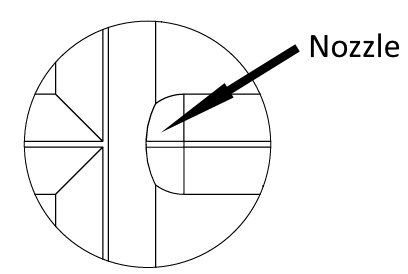
Nozzle location

Around the junction, the channels have a height of 83µm and a width of 88µm. The inlet/outlet channels have a height of 83µm and a width of 433µm.

This design doesn't includes on-chip filters. It's recommended to use external in-line filters.

More Information
Unit of measurementpack of 3
CoatingHydrophobic coating
Interface typeTopconnect
Chip materialBorosilicate glass
FluidsWater droplets inside an oil flow (coated, hydrophobic surface)
Nozzle size50µm
Icon Label Description Type Size Download
PDF DGFF.50 - Drawing Drawing for 50µm Topconnect Focused Flow Droplet Generator. Items 01366 and 00877. PDF 179.6 KB Download
pdf Droplet Generator Guide pdf 617 KB Download
pdf DGFF.10 - Drawing Drawing for 10µm Topconnect Focused Flow Droplet Generator. Items 01341 and 00935. pdf 159.2 KB Download
PDF DGFF.75 - Drawing Drawing for 75µm Topconnect Focused Flow Droplet Generator. Items 00970 and 00580. PDF 193.6 KB Download
pdf Surface wetting properties pdf 220.3 KB Download
pdf Flow rate instructions pdf 303.6 KB Download
pdf How to prevent clogging pdf 153 KB Download
pdf Using the right surfactants pdf 168.8 KB Download
Customer Questions
How do I clean my uncoated chips?
1) Flush an alkaline solution through the channels, like 1 M sodium hydroxide in water. 2) A water bath with ultrasonic agitation can be used to remove particulated matters, keep energy levels initially low to prevent potential damages. 3) Glass microchips can be heated (e.g. 400°C) causing any organic material on the glass surface to degrade. Try to use lower temperatures first because burning the content could make it stick. 4) Concentrated sulfuric acid works well to dissolve organic material, such as fibres, that are difficult to remove with alkaline solutions.
I need a pumping system for my droplet setup. Which one do you recommend?
We recommend using a high precision pumping system. Regular syringe pumps often don't work very well for droplet generators. There are several high precision pumping systems on the market that work with different pumping principles. To name one, we'd like to mention that we have had positive experiences with the equipment Fluigent offers.
Which flowrates should I use?
Advice on how to find the right flow rates and to to change the droplet size can be found under "Read More".
I only see streaks of fluids but no droplets. How do I get the droplets?
When you only see streaks of fluids its important to decrease your flowrate. Instructions to find the right flow rate can be found under "Read More".
Which surfactants should I use?
Tween 20, Tween 80 and Emulseo FluoSurf™-O surfactant are used in combination with our chips. See "Read More" for details.
How do I prevent clogging of my chips?
Clogging can only be avoided by working as cleanly as possible. Typical sources of particles include: - Dust from the air or open surfaces - Larger particles or other contamination in the fluids - Dried or solidified residues when re-using chips from previous runs - Components within the fluidic setup (e.g., tubing, connectors, reservoirs) - Residual particles remaining after cleaning See “Read More” for detailed advice on minimizing these risks.
Should I use coated or uncoated droplet generators?
For water-in-oil droplets, use droplet generators with a hydrophobic coating.For oil-in-water droplets, no additional coating is needed. Below more details on surface wetting properties are explained.Surface wetting propertiesThe contact angle between the fluid and the droplet generator surface is key for defining the stability of the wetting of the continuous phase. If the wetting is more preferential for the dispersed phase, pinning of the droplets to the channel can occur. The standard uncoated droplet generators of Micronit are glass based, thus hydrophilic and are suitable for making organic droplets in an aqueous phase (oil-in-water droplets). It is possible for Micronit to provide a coating which renders the surface of the droplet generators hydrophobic, thus suitable for making aqueous droplets in an organic phase (water-in-oil droplets). This coating is based on a fluorinated polymer and ensures the coated surface has a contact angle of more than 90° with water.
Publication: Controlled and tunable polymer particles' production using a single microfluidic device
Amoyav, Benzion, and Ofra Benny. "Controlled and tunable polymer particles’ production using a single microfluidic device." Applied Nanoscience (2018): 1-10.
Publication: Spatiotemporal variation of endogenous cell-generated stresses within 3D multicellular spheroids
Lucio, Adam A., et al. "Spatiotemporal variation of endogenous cell-generated stresses within 3D multicellular spheroids." Scientific reports 7.1 (2017): 12022.
I have a Elveflow OB1 pressure based pump what connectors do I need?
You need a combination of items supplied by Elveflow and Micronit. Please take a look at the full answer for more details.
I have a Fluigent pressure based pump, what connectors do I need?
See "Read More" for advice.
Can I use fluorinated oils in combination with coated chips?
Yes, you can. Fluorinated oils are already successfully used in combination with our chips.
What's important in selection of a suitable microscope objective?
The objective working distance is a critical parameter for selection of an objective. See "Read More" for recommendations.
What is the roughness of the etched structures?
Wet etched structures are extremely smooth and have a roughness in Angstrom range. The structures are fully optical transparent.
Does those droplet generators work well with Emulseo surfactants and Oils?
Micronit hydrophobic coated Glass Droplet generators are tested with the combination of Emulseo FluoSurf-O™ surfactant and Emulseo FluoOil™ 7500 oil and good results are obtained.
Would you like to submit a question? Please login first.
Copyright © 2020-present Micronit B.V. All rights reserved.