
shopping_basket
Choosing the right glass or silicon microfluidic chip size
- Expertise
- Reading time: 3 minutes
Choosing the right glass or silicon microfluidic chip size

Choosing the right glass or silicon microfluidic chip size is very important, because the size of the chip directly affects manufacturing cost, yield, and design freedom. Processing efficiency depends on how well chips fit on a wafer, while smart layout choices prevent unnecessary blank space. And handling requirements can often be solved with cartridges instead of larger chips. Most importantly, chip size optimization determines how smoothly a product can upscale in the future. This blog explains how each of these factors plays a role, and why early decisions can make a big difference later on.
Ease of processing and upscaling
Chip size determines how efficiently microfluidic devices can be manufactured and scaled because production is optimized at wafer level, not per individual chip.
Glass and silicon microfluidic chips are fabricated on wafers, where multiple chips are processed simultaneously and many steps are performed in batches. As a result, the main cost drivers are the number of wafers and processing steps rather than the number of chips produced.
Not only do larger chips reduce the number of devices per wafer, it also increases the chance that defects or artefacts results in the rejection of a chip, lowering yield and driving up costs during scale-up.

Functional design and blank area
An efficient chip design minimizes blank space to reduce footprint and improves manufacturability without compromising functionality.
Smart design choices, such as optimized layouts and multiplexing multiple designs on a single chip, help maximize the value of each wafer. This can be achieved by repeating channel structures or varying channel designs or dimensions within one chip design. When applying multiplexing, it’s important to minimize empty areas as much as possible. If this is not feasible, splitting the design into multiple smaller chips may be a more efficient solution.
Chip handling considerations
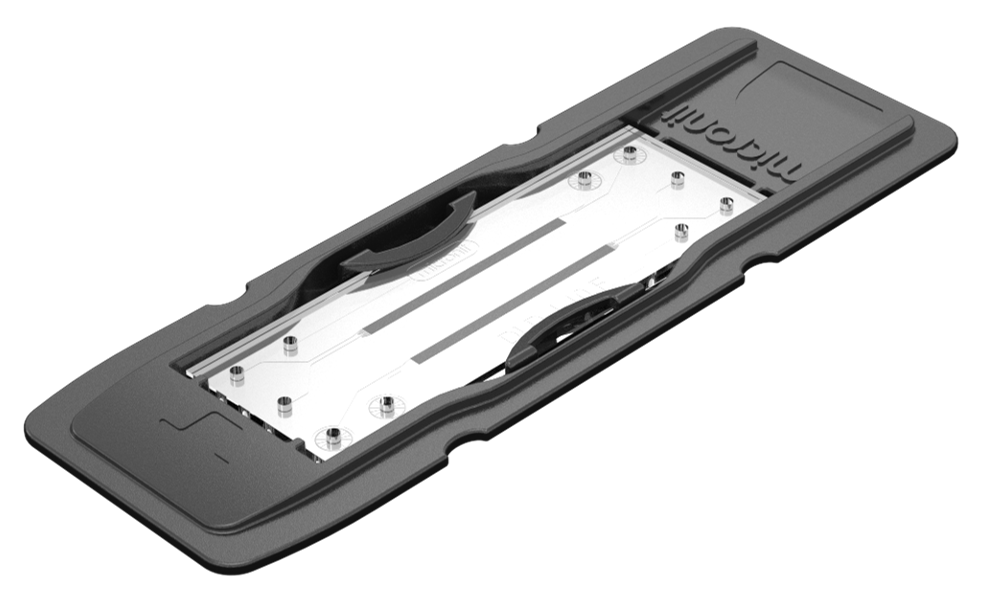
Cartridges allow smaller glass or silicon chips to be used while still meeting handling, integration, and system requirements.
In some cases, chip size is driven by customer setups or instrument interfaces rather than microfluidic functionality. Cartridges, typically made of plastic, provide mechanical protection for brittle materials and make chips easier to handle. They also improve integration into instruments, simplify alignment and readout, and enable automation through features such as barcodes or identifiers.
Cartridges are widely used across microfluidic applications. A well-known example is Thermo Fisher’s GeneChip™, but also Micronit’s own chips use this principle. By using a cartridge around our smaller-sized flow cells to fit a standard microscope slide format.

These examples show that smart design is not just about making chips smaller. But about making the entire system (chip and setup) more efficient, robust, and scalable.
Designing for the future
Early optimization of chip size is essential to avoid costly redesigns and inefficiencies when scaling to higher production volumes.
Chip size may not always stand out during early development, but as production scales, it becomes a crucial factor. Directly influencing cost per chip and ultimately the viability of the business case. Designs that are not optimized for wafer-level production often require adjustments later, leading to delays and additional costs. By considering chip size, cartridge use, and manufacturability from the start, companies create designs that scale smoothly and remain cost-effective.
At Micronit, we combine design-for-manufacturing expertise with in-house production of glass and silicon microfluidic chips. By advising customers early on chip layout, cartridge integration, and system compatibility, we help ensure both short-term efficiency and long-term scalability. Interested in optimizing your microfluidic chip design for manufacturing and scale? We’re happy to think along with you: from first concept to high-volume production.
Working together
Get to know more about Micronit Services and Expertise


